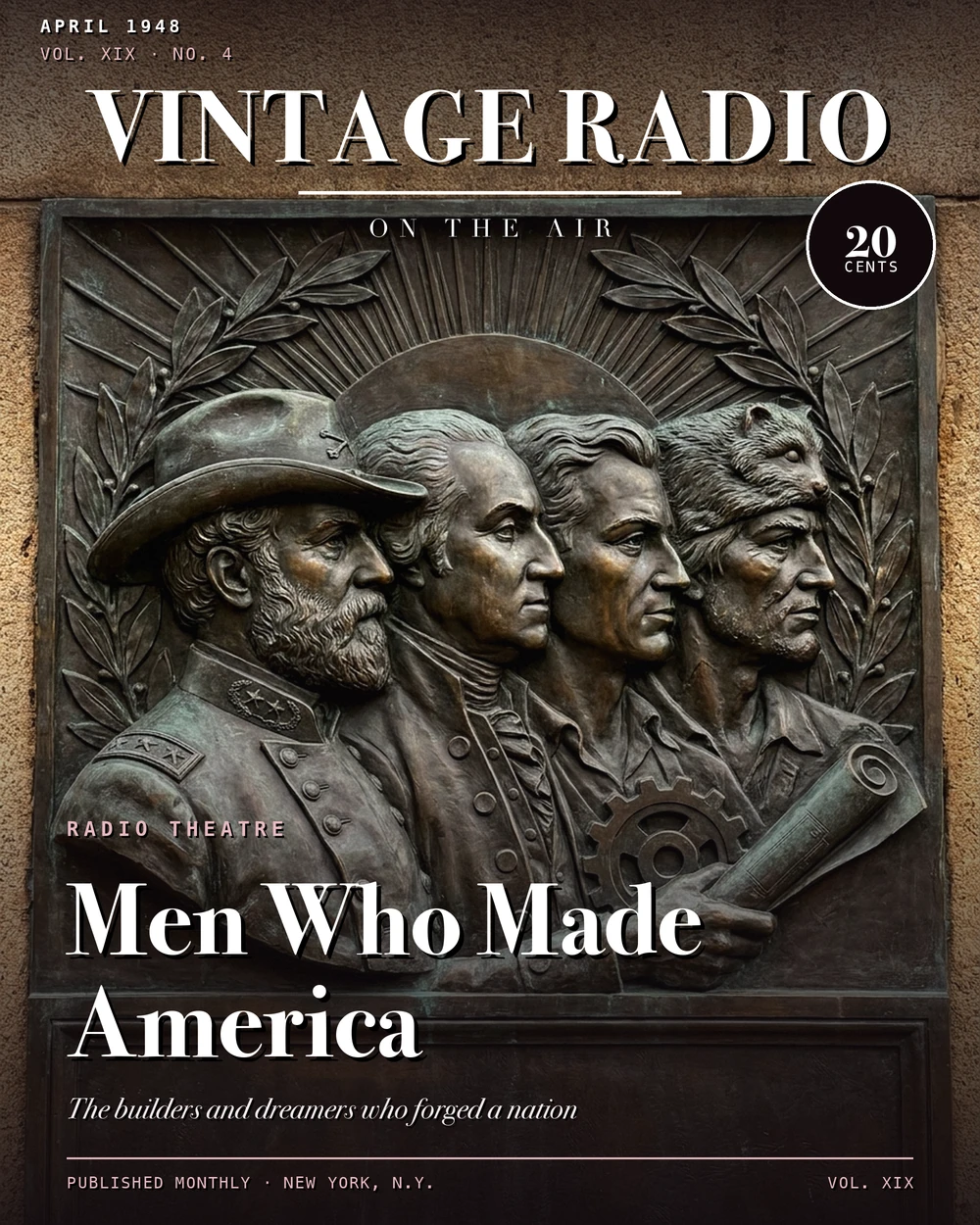
Men Who Made America
What the Show Was
Men Who Made America ran for ten episodes in the spring of 1937, from February 4 through April 22. The title suggests a tight focus on Gilded Age industrialists — the Carnegies and Rockefellers of American legend — but the episode titles tell a different and more interesting story. Alongside episodes that might plausibly profile a railroad baron or a banking titan, the catalog includes "Story of Johnny Appleseed," "The Corn Grows Tall," "Sun Magic," "The Dean Without A College," and "November's Child." None of those titles point to a robber baron. They point to something broader: folk heroes, agricultural figures, educators, and other Americans whose lives the series apparently felt were equally worth dramatizing. The show's actual scope was likely wider than its title implied.
No network affiliation, sponsor, writer, director, or confirmed cast has turned up in the public record. What survives is a list of ten episode titles and the dates the series ran. That's a thin paper trail, but the episodes themselves remain, and they carry their own evidence about what the show was trying to do.
The Episodes and What They Suggest
The ten known episodes cover a striking range. "Mightier Than The Sword" and "Prophet Without Honour" read like dramatizations of writers, journalists, or reformers — figures who changed America through ideas rather than capital. "Forty Two Years" and "The Gray Spirit" are harder to place, but their titles suggest a biographical approach, the kind of episode organized around a life's span or a defining personal quality rather than a single achievement. "And They Are Ours" has the sound of something patriotic or civic, possibly about a figure associated with public service or land.
"Story of Johnny Appleseed" is the most legible of the group. John Chapman — the historical figure behind the Johnny Appleseed legend — spent decades in the late eighteenth and early nineteenth centuries planting apple orchards across the frontier Midwest. By 1937, his story had been a staple of American folklore for generations, the kind of figure a history series would naturally reach for when building an episode about ordinary people who left a lasting mark. "The Dean Without A College" similarly implies an educator or intellectual who operated outside traditional institutions — another kind of American maker, just not the kind who built a steel plant.
Taken together, the episode titles suggest a series with a democratic instinct about who counts as someone who made America. The industrialists of the Gilded Age are the obvious candidates for a show with this title, but this particular program seems to have looked well past that narrow group.
The 1937 Radio Context
By the time Men Who Made America reached listeners in the winter and spring of 1937, radio had become the country's dominant mass medium — "America's first mass medium," as a contemporary description put it, linking the country and ending the isolation of rural residents. Three networks carried programming to that nationwide audience: NBC, operating its Red and Blue chains across roughly 110 stations; CBS, with 101 stations on a single network; and the Mutual Broadcasting System, with 45. A short biographical series airing in that environment could reach listeners who, only a decade earlier, would have had no practical access to dramatized history at all.
History and biography programming had real standing in 1930s radio. That same 1937 season, NBC put John Barrymore on the air in Shakespeare adaptations, and CBS presented Claude Rains in a dramatization of Julius Caesar. Audiences had an appetite for historical and literary content, and networks — particularly NBC's Blue chain, which built much of its identity around classical music, regional content, and public service programs — had reasons to serve it. A ten-episode run of dramatized American lives fit naturally into that landscape, even if the specific network that carried Men Who Made America hasn't been confirmed.
What Remains
Ten episodes represent a complete or near-complete run for a short series, and their survival gives a reasonable picture of what the show attempted — if not always of exactly who appeared in it or who made it. The ambiguity in the episode titles is itself informative: this was a series comfortable with a broad definition of American significance, willing to put a folk nurseryman or an unconventional educator in the same company as the titans the title seems to promise.
The production details — who wrote the scripts, who performed the roles, who directed the broadcasts — remain unknown. That kind of obscurity isn't unusual for short-run 1937 series that were never attached to a major sponsor or a prominent name. What the record does preserve is the shape of the thing: a ten-week run of dramatized American biography, airing during one of radio's most culturally ambitious seasons, reaching for a version of American history that was apparently larger than its own title suggested.